What does it really mean to BE conscious?
On care, privilege, and what consciousness actually asks of us.
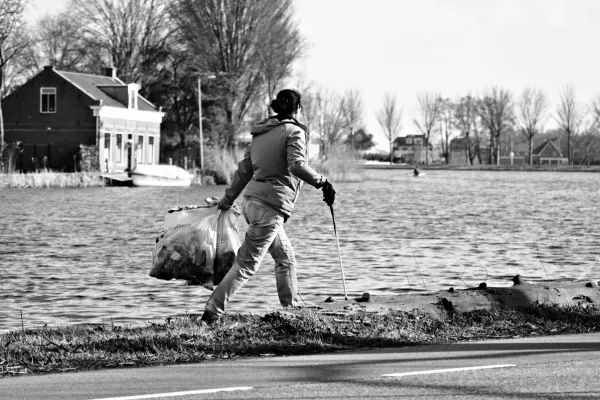
A man walks by. Bucket in hand, gathering rubbish from front gardens and footpaths, that seemingly escaped from the collection bins. Quietly, humbly caring. A woman knocks on the door of a 70-year-old neighbour who has just lost his 2 children. He opens the door, tears cascading down his cheeks, as his body struggles to remain upright. She pops the homemade soup and cookies in the kitchen, and without words, gently holds him. A child walks along the street, holding hands with her mother. She sees a homeless man solemnly staring into the ether, huddled in his torn blanket. She asks her mum to stop. She gives him her favourite soft, snuggly bear - a bear that has given her comfort for as long as she can remember. She says to him: “He makes me feel safe. Here, I want you to have him.”
Not a camera in sight. No glamourous, insta-worthy shots. Just real, caring presence.
In the wellness world, self-awareness is often considered as synonymous with being conscious. If I’m “doing the work”, I’m conscious. But what does doing the work actually mean? Am I cycling in my mind, stuck in stories of past, ruminating and focusing on potential triggers? Am I moving in and through my challenges, or using them to make excuses for my behaviour? Yes, self-awareness and self-development are imperative aspects of becoming more conscious. But there is a line where too much “self” focus can become self-indulgence, and hyper-fixation on the inner processes, at the expense of connection and presence with the outer world.
What’s striking, is that the traditions the wellness world so readily borrows from, never understood consciousness this way. Take Kanyini, an ancient philosophy from the Pitjantjatjara and Yankunytjatjara peoples of Central Australia. I offer only a surface introduction here, because my knowledge and summary will not do justice to its depth of meaning. As I understand it, at its core, Kanyini describes unconditional love coupled with deep responsibility - to spirit, to family, to all of humanity, and to Country. Love and responsibility are inseparable. The focus is relational, not individual. There is no separation.
I recall a moment, when working on these Lands, representing seven brothers for various crimes, using my limited Pitjantjatjara and drawing with sticks in the dirt to piece together what happened. With the interpreter having momentarily disappeared, it was quite chaotic. Limited time to gather important information, the court putting pressure on us to present our case, and a queue of people waiting for support. Amongst this chaos, I experienced something quite profound. While communicating with their father, I realised that I couldn’t tell where his feet ended, and the earth began. He was the earth, and the earth was him. The inseparability was palpable. Shivers ran through my body as I understood what true connection really was and the possibilities of this in human form. I still remember that moment vividly, 20+ years later.
In many indigenous traditions, the more spiritually developed you become, the more accountable you are, to community, to land, to the living world around you. The connectivity, symbiotic relationality, is embodied wisdom, on a spirit and cellular level. Consciousness was never meant to be a solo development project.
Being conscious starts from care. Yes, care for the self, but also care for the other – for land, for people, for animals, for all that is. True consciousness recognises the interconnectedness of all, and therefore the importance of care and consideration for all. When we are born into privilege, there is no excuse for abandoning this relational care. Some of the most impoverished places I have been, have had the greatest presence of community care. There is an innate knowing that care is an “us” and not an “I”.
When privilege collapses inward, “consciousness” focuses on self-optimisation. Retreats, ceremonies, exclusive gatherings & spiritual aesthetics abound. Buying up land to build multi-million-dollar wellness centres, at the expense of locals and wildlife is seen as ‘success’. “The work” of becoming is done in service of the self, with the illusion of care blanketing the profiteering lying underneath - whether that be through monetary gain, land grabbing, or egoic prestige.
Privilege collapsing outward is just as unconscious, yet in different ways. When this happens, the saviour takes hold and burn out closely follows. I know this pathway well. As a young lawyer, I cared so much about my work for those less privileged than me. Working in indigenous and low-socio economic communities, I strongly believed that because I was born with privilege, it was my duty to do this work. I poured my heart and soul into it. I took it home with me, preparing cases for court by night, worrying about whether I would get the best outcome for my client, whether they would go to jail, or be able to access a supportive rehabilitation program. Some days I’d have 50 people wanting my support, which I managed by adrenal activation. I took on responsibility for it all. When it worked in my favour, I celebrated. When it didn’t, I crashed into a pit of self-blame and devastation. Care for myself was something I tacked onto the end of a day if there was time for it, or if exhaustion took over. And yes, that work took its toll. A few years in and I completely burned out. Over-caring, over-giving, & over-responsibility were my downfall.
After that first burnout, witnessing the Western takeover in impoverished, colonised communities of Latin America, I struggled to know what next. How could I best support the change I wanted to see in the world, when I was a part of the problem? How could I find a way forward of care, that didn’t end up with me in utter depletion? This contrast of Western indulgence on colonised Mayan lands certainly wasn’t the way for me. So, what was? It was confronting, confusing and I had no answers. I thought immersing myself into silent meditation for 3 months, studying the tarot, sacred geometry and the Kabbalah, might help me find the answers. That maybe the inward focus would provide me with the key to life. I didn’t discover that key, but I certainly replenished myself and learnt incredible lifelong skills in deepening my attunement and presence.
One thing that did become clear, was that focusing on extreme outward care or extreme inner care were not the answer, nor was yoyoing between the two.
A few months later, life answered the question I’d been sitting with – not in a meditation, but in a dirt paddock, beside a Russian tractor in Cuba. My body had been flattened into the soil, wheel-by-wheel, by this huge mechanical force, with the sugar cane trailer, destined for my head, rolling to a halt, inches from my skull. Breath strained, body bleeding and broken, on the precipice of death. I felt the crushing weight, the reality that my injuries were dire, but in my mind, it seemed so surreal, something made for the movies, not my actual life. Was I in it or watching it? I wasn’t 100% sure.
In this liminal, timeless space, I slowly became the dirt, the tractor, the sugar cane trailer, the bushes, the trees. Like water pouring over land, I kept expanding, becoming all that is, both animate and inanimate. The expansion continued, and like air expanding through space, I started to become the atmosphere, the clouds, the stars, the galaxies, expanding out until I was everything. I was both Sophia and everything all at once. It was a feeling of pure bliss, peace, love. A sense of oneness so complete, it left no room for separation between self and other. And what it showed me was this: we are not separate beings having occasional spiritual experiences. We are loving consciousness itself, moving through human form. The key to life, I came to understand, is being this love in human form. And that means the way we move through the world - how we are being with ourselves, with the person in front of us, the community around us, the land beneath our feet, the animals beside us - is the spiritual practice, and it’s all inclusive.
So, what does this really look like in practice? The balance point, of inner and outer attention is harder to describe than the extremes. It’s creating space to sit in silence, to listen and be deeply present. It’s awareness of your capacity to give, and what you need to resource yourself enough to keep giving. It’s knowing where your responsibility lies, and leaning into, not beyond, that boundary. It’s recognising the importance of grounded stability as a baseline, from which to reach out into the world with care. It’s experiencing yourself as part of a whole,where how you breathe, how you rest, how you set a limit, matters as much as how you show up. It asks for discernment rather than sacrifice. Presence rather than performance. Replenishment rather than extraction. And it is usually unglamorous.
When we have privilege, conscious expression invites us to step into leadership. With resources, access to education, therapy, relative safety and freedom, we have more than many on the planet. It’s a capacity that asks a very specific question: What are you doing with it and at whose benefit or expense? When we sit in consciousness at this balance point, we can answer that question, without collapsing into guilt, hiding in avoidance, inflating into saviour or morphing into people pleaser. This is leadership in its true sense: how we lead in our personal relationships, including that with ourselves, as well as how we lead professionally and environmentally. It requires deep attunement and brutally loving honesty. This means owning our shit. Owning our impact on the world - where it replenishes and where it depletes - and doing what we can to tip the balance into collective restoration.
I return my gaze to the street. Another neighbour, carrying a home-cooked meal, walking towards the house where the man grieving his 2 children resides. My heart softens in the beauty of this simple act of care. Leadership in motion, in the ordinary. No followers. No documentation. No desire to be noticed. Just pure, humble, loving action. That’sbeingconscious.